

Digital Print vs Offset Quality Explained
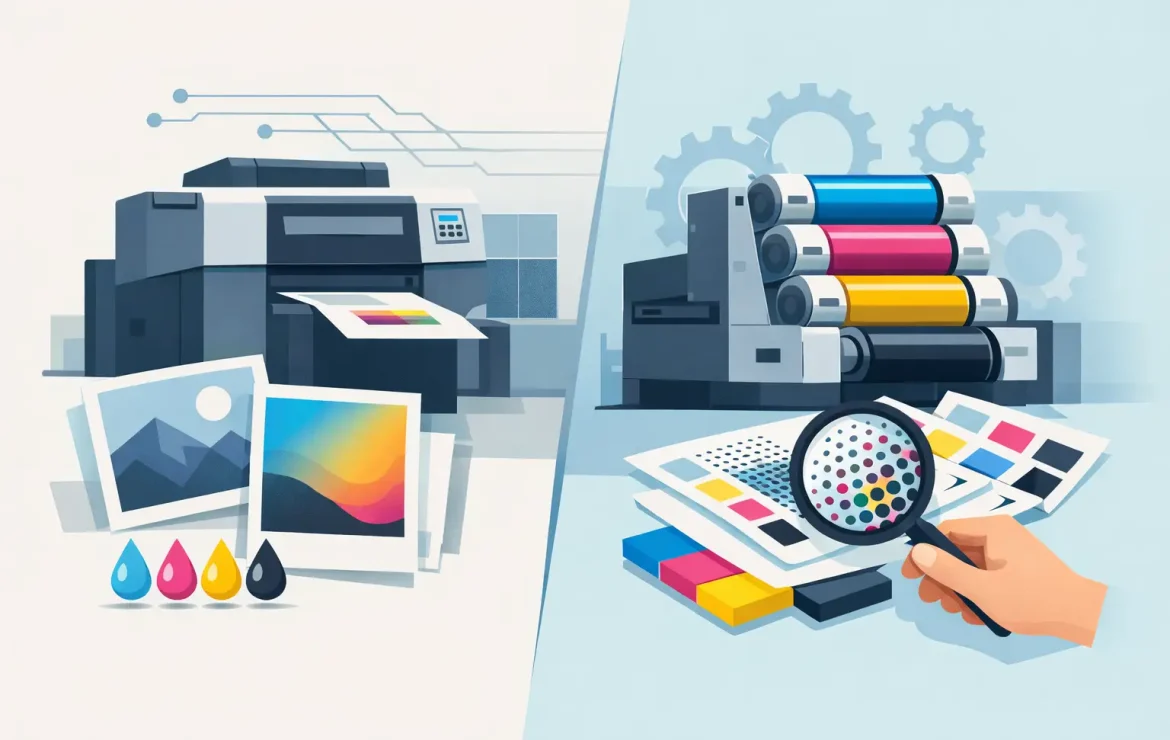
If you are comparing digital print vs offset quality, you are probably not looking for a lecture on print machinery. You want to know one thing – which option will make your brochures, leaflets, menus or booklets look right for the job, stay within budget and arrive without fuss.
The honest answer is that both can produce excellent results. The better choice depends on what you are printing, how many you need, how closely colours must match and what the finished piece is meant to do. For many business print jobs, the gap in quality is much smaller than people expect. What matters more is choosing the right process for the purpose.
Digital print vs offset quality – what is the real difference?
Digital print applies artwork directly from file to sheet. Offset, often called litho, uses printing plates and is traditionally the go-to option for longer runs and highly controlled colour work.
From a customer’s point of view, the quality difference usually shows up in consistency, colour precision and how the ink sits on the stock. Offset has long been known for very accurate colour reproduction, especially across large quantities. Digital has improved massively and now delivers sharp, professional, full-colour results that are more than good enough for a huge range of commercial print.
That is why this is not really a question of good versus bad. It is a question of best fit.
Where offset still has the edge
Offset print is often the stronger choice when colour needs to be tightly controlled across a large run. If you are printing a high-volume brochure, a corporate report, a branded campaign or a piece where colour consistency matters from the first copy to the last, offset gives you a high level of stability.
It also handles certain paper stocks and finishing combinations very well. Solid areas of colour can look especially smooth, and subtle tonal work can be beautifully controlled. If your brand has specific Pantone colours or you are producing premium marketing materials where every detail is being scrutinised, offset often gives you more control.
There is also the matter of scale. Once quantities increase, offset becomes more cost-effective per unit, and that can make it the smarter commercial choice as well as the quality choice.
That said, offset is not automatically the winner just because it has a traditional reputation. If you only need a small run or your artwork may change, paying for plates and setup can be unnecessary.
Where digital print performs brilliantly
Digital print has become the practical favourite for a lot of business printing because it is fast, flexible and consistently high in quality. For short runs, regular reorders, versioned artwork and quick-turn marketing materials, it makes a lot of sense.
The print can be crisp, colours can be vibrant and text can be very sharp. For everyday commercial pieces such as flyers, business cards, booklets, presentation folders and event handouts, digital often delivers exactly the standard businesses need.
It is especially useful when you do not want to commit to a large quantity. If you are testing a new leaflet, updating a menu, printing a small batch of training booklets or creating targeted versions of a mailer, digital helps you stay agile without sacrificing a polished finish.
This is where many buyers change their minds. They start by assuming offset must mean better quality, but once they see a well-produced digital job on the right stock, they realise the result is more than strong enough for the intended use.
Quality depends on more than the print method
A lot of people frame the discussion as digital print vs offset quality, but the process is only one part of the result. Artwork, stock, finishing and file setup all matter just as much.
A beautifully designed brochure with strong images, correct colour settings and a suitable paper can look excellent in digital. A poorly prepared file printed offset will still look poor. Likewise, a flimsy stock can make even good print feel underwhelming, while the right uncoated or silk stock can lift the whole piece.
This matters because many quality complaints are not really about digital versus offset. They are about low-resolution images, unexpected colour shifts, unsuitable paper choices or design decisions that do not translate well to print.
That is why straightforward advice from a print team helps. It keeps the conversation focused on the outcome rather than just the machine.
Colour accuracy and brand consistency
If your business relies on tight brand standards, colour accuracy deserves special attention. Offset is often better when exact colour matching is critical, particularly over long runs or when using spot colours.
Digital can still produce very strong colour, and for many organisations it is absolutely suitable for branded print. But if you place a digitally printed leaflet next to an offset-printed folder and a wide-format banner produced on a different device, there may be slight variations. That does not mean any one item is poor quality – only that different processes reproduce colour in slightly different ways.
For some buyers, that distinction barely matters. For others, especially larger organisations or brand-led businesses, it matters a great deal. If your print will be viewed side by side across multiple formats or over repeat campaigns, it is worth discussing colour expectations early.
Text, images and fine detail
Both methods can reproduce fine detail very well, but they do it slightly differently. Digital is typically excellent for sharp text and clean graphics, which is one reason it works so well for business stationery, short-run booklets and promotional pieces with lots of information.
Offset has a reputation for very smooth image reproduction, particularly in larger runs and premium marketing materials. Skin tones, gradients and subtle photographic detail can look especially refined when the job is well specified.
Still, this is not a dramatic divide in every case. On many common business print products, the difference is modest enough that most end users will not notice unless they are comparing samples directly.
Quantity changes the conversation
If you need 100 brochures, digital is usually the practical answer. If you need 10,000, offset becomes much more attractive. This is partly about cost, but it also affects quality expectations.
With offset, the upfront setup is greater, so it tends to make sense when you want long-run consistency and value at volume. With digital, you avoid that setup burden, which makes short and medium runs more efficient and more flexible.
This matters for growing businesses. Ordering smaller quantities more often can be better than storing outdated print. There is little value in chasing a marginal quality gain if half the stock becomes irrelevant after a pricing change, a rebrand or a new offer.
So which should you choose?
Choose digital if you need shorter runs, fast turnaround, versioned artwork or excellent everyday print without overcommitting on quantity. It is ideal for a large share of modern business print, and the quality is far stronger than outdated assumptions suggest.
Choose offset if colour control is critical, quantities are high, the finish needs to feel especially premium or the job must match exact brand standards across a long run. It remains a very strong option for flagship marketing pieces and large-volume print.
In practice, many businesses benefit from using both. A company might print a high-volume corporate brochure offset, then use digital for updated inserts, event flyers, internal packs or localised campaigns. That is often the smartest approach – not loyalty to one process, but using the right tool for each print job.
For businesses in Sheffield and across South Yorkshire, this is usually where a good printer proves its value. Not by pushing one method, but by helping you weigh up quality, quantity, budget and deadlines in plain English.
The best print is the one that suits the job
There is no prize for choosing the more traditional process if it slows things down or inflates the cost. Equally, there is no point choosing the faster option if the piece needs a level of colour control that offset handles better.
The best result comes from looking at the whole job – what it is for, who will see it, how many you need and how important colour precision really is. When those pieces line up, both digital and offset can produce print you are proud to put your name to.
If you are unsure, ask to compare options against the actual product you need, not a generic rule of thumb. Good print decisions are rarely made in theory. They are made by matching the process to the purpose, then getting the details right.
Popular Posts

A Guide to Custom Sticker Printing for Business

What Is Uncoated Paper and When Should You Use It?

Ordering NCR Duplicate Sets Without Delays
Testimonials
We had some brochures printed – they were high quality and the delivery was right to our door and super speedy. The customer service was excellent and I would definitely use them again.

Causeway
Our friends at Print by Volta always do a cracking job and they are always friendly, helpful and full of ideas. And they are consistent year on year which is why we are still working with them!

LFBB Solicitors
Excellent print quality with a quick turnaround! The staff are very helpful and supportive. We will be sure to work with them again.

David Village Lighting

