

Brochure Printing for Companies That Works
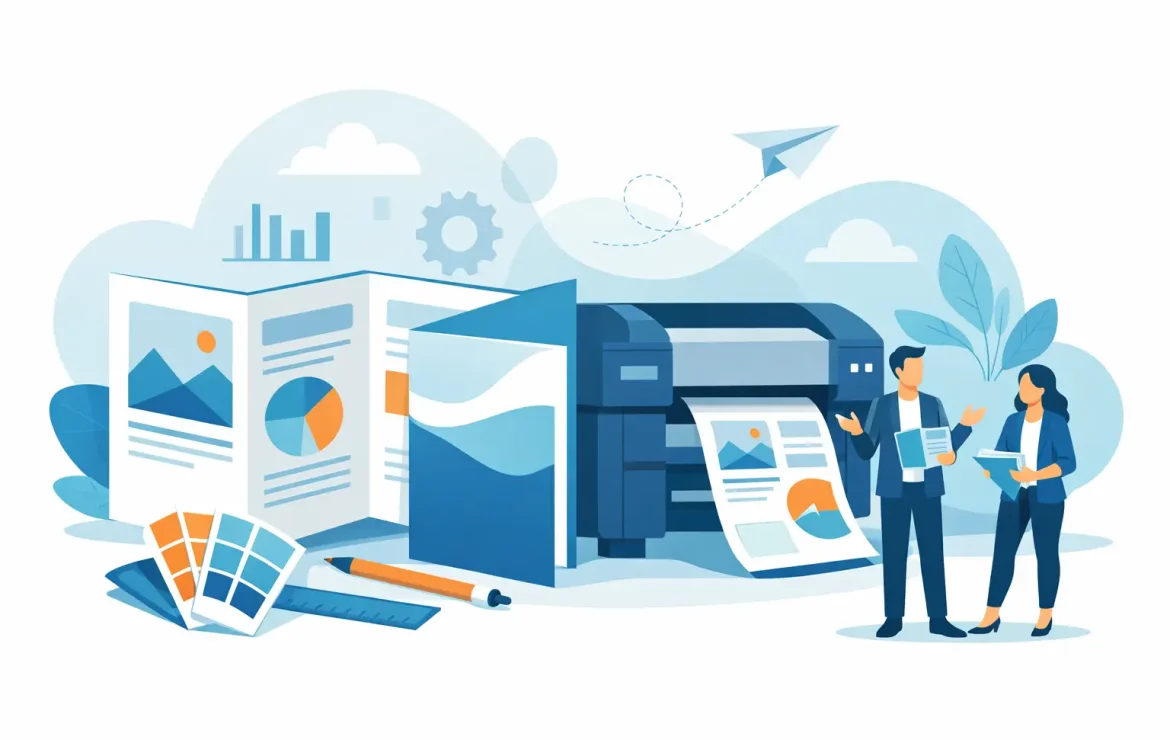
A brochure often gets judged in the first few seconds. The paper feel, the sharpness of the print, the way the pages sit in the hand – all of that shapes what people think about your business before they read a word. That is why brochure printing for companies is not just a production job. It is part of how you present your brand, your offer and your standards.
For some businesses, a brochure is a leave-behind for sales meetings. For others, it is a product guide, a menu, a prospectus, an event handout or a smart introduction to services. The format may change, but the purpose stays much the same. It needs to make your company look credible, organised and worth taking seriously.
Why brochure printing still matters for companies
Digital marketing does plenty of heavy lifting, but print still earns its place. A good brochure slows the conversation down in a useful way. It gives people something to keep, share and refer back to after the meeting, the exhibition or the visit to your premises.
It also works well when you need to explain more than a leaflet can comfortably hold. If your business has several services, product ranges, pricing tiers or case studies, a brochure gives you room to set things out properly without cramming everything onto a single sheet.
There is also the trust factor. Printed brochures suggest preparation. They show that you have invested in how your business is presented. In sectors where reputation matters – legal, property, hospitality, manufacturing, education, healthcare and professional services – that extra polish can make a real difference.
Choosing the right brochure printing for companies
The best brochure is not always the fanciest one. It is the one that suits the job, the audience and the budget.
If you need something compact for events, a stitched booklet is often a strong choice. It feels tidy, professional and easy to browse. If you are presenting a premium service or a detailed company profile, a heavier cover and a more refined finish may be worth it. If you are running a short campaign, launching a product or updating information regularly, digital print can make more sense because it keeps quantities flexible.
This is where businesses sometimes overcomplicate things. They start with paper weights and binding terms when the better starting point is much simpler. Ask who the brochure is for, where it will be handed out, how long it needs to stay relevant and what action you want the reader to take.
Once those answers are clear, the print specification usually follows more easily.
Start with the purpose, not the paper
A brochure for a trade show behaves differently from one used by a sales rep in face-to-face meetings. An estate agency brochure has a different job from a restaurant menu or a school admissions booklet. The format should support the way it will be used.
If the brochure needs to travel in post packs or fit neatly into presentation folders, size matters. If it will sit on a reception desk, appearance and durability matter more. If your team will be handing it out in volume, unit cost becomes a bigger factor.
Good print buying is rarely about choosing the most expensive option. It is about avoiding the wrong one.
Quantity depends on timing and change frequency
One of the biggest trade-offs in brochure printing for companies is run length. Printing more copies usually brings the unit cost down, but only if the content stays current. If your prices, service details or team information change often, storing thousands of brochures can become false economy.
Shorter runs are often the better call for growing businesses, seasonal campaigns and materials with regular updates. Larger runs tend to suit evergreen company brochures, long-term product catalogues and stable service literature.
A reliable printer should help you balance cost against waste, not simply push the biggest volume.
Design choices that affect print quality
Even the best press cannot rescue a weak layout. Strong brochure design is clear before it is clever. It needs a logical structure, readable type, a sensible image hierarchy and enough white space for the content to breathe.
Many company brochures try to say too much. That usually leads to dense pages, tiny text and a rushed feel. The better approach is to decide what the reader genuinely needs. What are the key services? What proof points matter? What should they do next? If every page tries to carry the whole business, none of it lands properly.
Images matter just as much. Low-resolution files, poorly cropped photos and inconsistent brand colours can make a brochure feel cheaper than it should. That is frustrating when the business itself may be excellent. If your brochure represents a serious brand, the artwork needs to do the same.
For companies without in-house design support, this is often where an experienced print partner adds real value. A straightforward conversation at the start can prevent expensive reprints and awkward compromises later.
Paper, finish and format without the jargon
Most buyers do not need a lecture on stock grades. They need practical guidance.
The cover is usually where you create impact. A slightly heavier cover gives the brochure presence and helps it hold up better in use. Inside pages should feel good enough to reflect quality, but not so heavy that the brochure becomes bulky or unnecessarily expensive.
Finish also changes the mood. Silk tends to feel smart and versatile. Gloss can make colours pop, which suits image-led work, but it is not always right for more restrained brands. Uncoated stocks can feel tactile and premium, especially where a natural or understated look is part of the identity. There is no single best option – it depends on the brand and the purpose.
Size is another practical choice. A4 works well for detailed information and strong visual layouts. A5 is compact and cost-effective. Square formats can stand out, but they are not always the most efficient for storage, display or distribution.
The point is not to make the brochure unusual for the sake of it. The point is to make it feel right.
Common mistakes companies make with brochures
The first is treating the brochure as an afterthought. A rushed update to an old file, sent to print the day before an event, rarely produces the best result.
The second is trying to appeal to everyone. A brochure with no clear audience tends to become vague. Broad claims, generic headlines and overloaded service lists may look busy, but they do not usually persuade.
The third is ignoring practical details. Contact information gets missed. Calls to action are buried. Brand colours shift from one page to the next. Margins are too tight. None of these mistakes are dramatic on their own, but together they make the brochure feel less professional.
There is also a tendency to over-specify. Not every company needs elaborate finishes or complex binding. Sometimes a well-designed, well-printed standard brochure will outperform a premium-looking piece that does not communicate clearly.
How to make brochure printing easier
The smoothest brochure projects start with a brief that is simple but complete. You do not need pages of print terminology. You need the basics: size, quantity, page count, intended use, deadline and whether artwork is ready.
It also helps to be honest about what stage you are at. If you have a draft layout but no final images, say so. If you are unsure about paper or format, that is normal. A good print supplier should guide you without making the process feel complicated.
For many businesses, the easiest route is working with a team that can handle both the print and the creative side. That removes the back-and-forth between designer, marketer and printer, and it reduces the risk of artwork problems holding things up. For busy teams, that joined-up support saves time as much as money.
That is one reason businesses choose Print by Volta. The process stays straightforward, the advice stays practical and the finished brochure looks like it belongs to a company that knows what it is doing.
Brochure printing for companies is about confidence
A brochure should make life easier for your sales team, clearer for your customers and stronger for your brand. It should help your business look prepared, consistent and credible in the moments that matter.
That does not mean every brochure needs to be elaborate. It means it needs to be well judged. The right format, the right print method and the right finish can turn a routine piece of marketing into something that actually gets used.
If you are planning your next brochure, start with the practical questions and build from there. When the message is clear and the print is right, people notice – and they tend to keep it.
Popular Posts

A Guide to Custom Sticker Printing for Business

What Is Uncoated Paper and When Should You Use It?

Ordering NCR Duplicate Sets Without Delays
Testimonials
We had some brochures printed – they were high quality and the delivery was right to our door and super speedy. The customer service was excellent and I would definitely use them again.

Causeway
Our friends at Print by Volta always do a cracking job and they are always friendly, helpful and full of ideas. And they are consistent year on year which is why we are still working with them!

LFBB Solicitors
Excellent print quality with a quick turnaround! The staff are very helpful and supportive. We will be sure to work with them again.

David Village Lighting

