

10 Best Print Products for Exhibitions
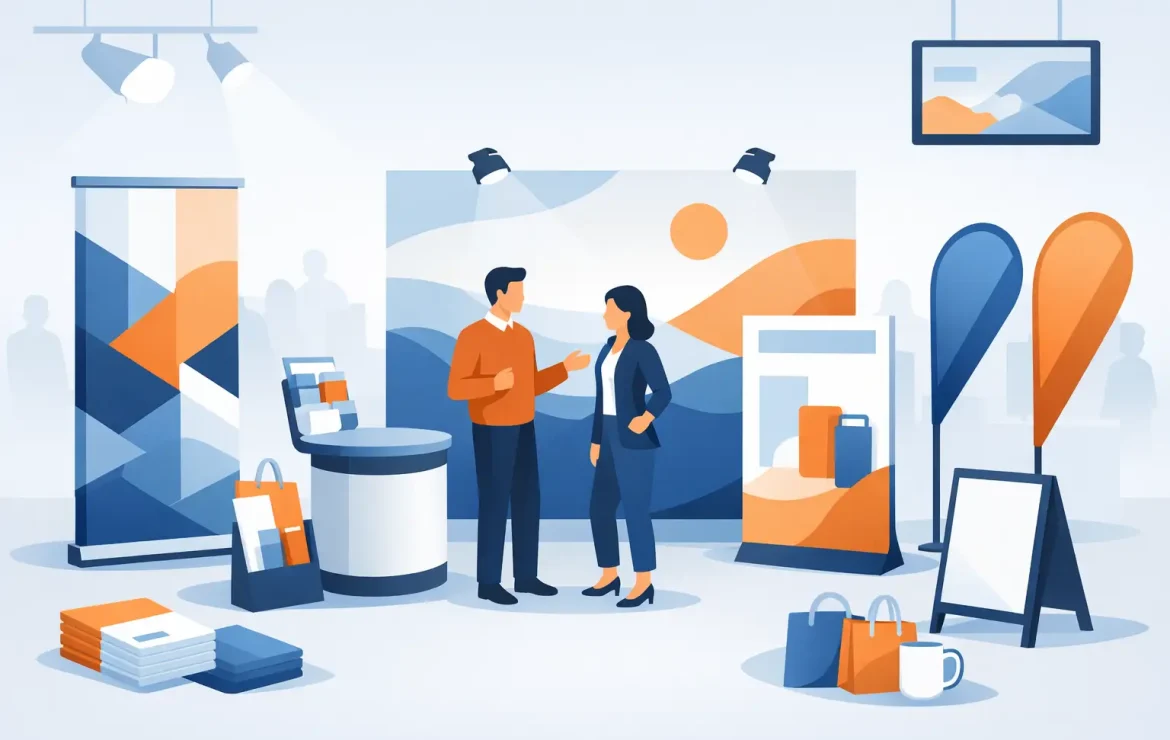
A busy exhibition stand gives you about three seconds to make sense. Not three seconds to explain your service, your pricing and your process – just enough time for someone walking past to decide whether you look worth stopping for. That is why choosing the best print products for exhibitions is less about ordering everything with your logo on it and more about picking the pieces that do a clear job.
Some products pull people in from a distance. Some help your team start conversations. Others do the quieter work afterwards, when a visitor gets back to the office and finally looks through the material they picked up. The right mix depends on your stand size, your budget, your audience and how people are likely to move through the event.
What makes the best print products for exhibitions?
The best exhibition print does one of three things well. It gets you noticed, it helps people understand what you do quickly, or it gives them something useful to take away. The strongest stands usually cover all three without feeling cluttered.
That means quality matters, but clarity matters more. A beautifully printed display with too much text will still be ignored. Equally, a cheap-looking banner can make a good business look underprepared. If you are choosing where to spend, start with products that support visibility and clear messaging, then build out from there.
Roller banners are still one of the safest bets
Roller banners remain one of the most practical exhibition products because they are portable, quick to set up and easy to reuse. For smaller stands, they often do a lot of the heavy lifting. Even on larger stands, they can support key areas such as entrances, meeting points or product zones.
Their real value is distance. A good roller banner tells visitors who you are and what you offer before anyone on your team says a word. That only works if the design is disciplined. One message, one strong headline, a short supporting line and clear branding usually beats a banner packed with bullet points.
There is a trade-off, though. Roller banners are cost-effective, but they do have physical limits. If your stand is trying to make a premium impression at a major industry event, a wider format backdrop or a more integrated display may give you a stronger finish.
Large-format backdrops set the tone fast
If you have the space, large-format exhibition graphics often make the biggest difference to how professional your stand feels. A backdrop creates presence, gives your team a branded environment to work from and turns an empty shell scheme into something far more considered.
This is especially useful when your exhibition hall is crowded with similar businesses. People are not comparing your message in a quiet room. They are comparing your visual confidence against dozens of nearby stands while walking with a coffee and checking their next meeting time.
Backdrops do need more planning than smaller products. Artwork has to be right, images need to hold up at scale and your message must stay readable from a distance. But if the event matters, this is often where budget has the most visible effect.
Brochures and booklets help you stay remembered
Not every visitor wants a brochure, but the right brochure is still one of the best print products for exhibitions when your offer needs a little more explanation. If you sell a higher-value service, multiple product lines or something that requires internal sign-off, a well-designed brochure gives prospects something they can take back and share.
The mistake is trying to make it do everything. Exhibition brochures work best when they are selective. Focus on your strongest offer, core benefits, case study snapshots and clear contact details. Keep the language direct. No one is standing on a train home reading six pages of marketing waffle.
For some businesses, a compact booklet or stitched brochure feels right. For others, a simple folded leaflet is the better fit. It depends on the complexity of the offer and the type of visitor you expect. A local service business may not need a glossy catalogue. A manufacturer with several product ranges might.
Leaflets are useful when speed matters
Leaflets have one big advantage at exhibitions: they are easy for people to pick up without commitment. If your aim is broad awareness, event offers or a short introduction to a service, they can work very well.
They also give you flexibility. You can tailor them to a specific campaign, product launch or audience segment without the cost of a more substantial brochure. That matters if you attend several events a year and need to keep your material current.
The downside is obvious. Leaflets are easier to throw away. To earn their place, they need a strong front cover, a clear reason to keep them and information that is genuinely helpful. A vague sales handout will disappear quickly.
Business cards still matter more than people admit
Exhibitions are full of digital follow-up promises that go nowhere. A business card still gives contact details a physical presence, and that matters when someone is sorting through conversations after a long day.
A good card should feel consistent with the rest of your stand. It does not need gimmicks, but it should be well printed, easy to read and sturdy enough to avoid looking disposable. If your team is meeting a lot of people quickly, business cards remain one of the simplest ways to make sure the right details change hands.
If you want to make them work harder, consider using the reverse for a short service list, appointment note space or key message. Just do not overcrowd it.
Presentation folders help with more serious conversations
Some exhibition leads are casual. Others are ready to talk properly. When that happens, a presentation folder can be far more effective than handing over loose sheets and hoping they survive the journey home.
Folders are particularly useful for sectors where credibility and order matter – professional services, education, training, manufacturing, property and B2B consultancy, for example. They let you combine tailored inserts, price lists, case studies or product sheets in a format that looks organised and deliberate.
They are not essential for every stand. If your event is fast-moving and visitor interaction is brief, folders may be more than you need. But for appointments, demos and conversations with decision-makers, they can lift the whole exchange.
Posters and mounted signage improve navigation on the stand
Posters are often overlooked because they feel basic, but they can be very effective when used with purpose. On an exhibition stand, they can highlight a product launch, reinforce a headline offer or direct visitors towards a demonstration area.
Mounted signage can do even more if your stand has zones or display counters. It helps visitors understand where to look without needing a sales pitch straight away. That is valuable because a stand that is easy to read tends to feel easier to approach.
The main thing is not to duplicate the same message everywhere. A poster should add something, not repeat what is already on your backdrop and banners.
Stickers and labels can be smart giveaways
Not every giveaway needs to be expensive. For some brands, stickers and labels are a simple, low-cost way to create visibility beyond the event itself. This works best in sectors where customers actually like branded items – creative industries, education, lifestyle, tech and community organisations, for example.
For a more traditional B2B audience, stickers may not be the main attraction, but they can still support packaging, sample packs or event handouts. As ever, relevance matters more than quantity. There is no point ordering a novelty item your audience will never use.
Promotional print should support the conversation, not replace it
Branded postcards, notepads and other promotional print can have a place at exhibitions, especially when they are tied to a campaign or useful takeaway. The strongest promotional items are practical. People keep things they can use.
That said, there is a budget question here. If funds are limited, put more into your display and your core printed literature first. A polished stand with clear sales material will usually outperform a table full of forgettable freebies.
How to choose the right mix for your event
If you are planning an exhibition stand, start with the visitor journey. What do people see first? What helps them understand you within a few seconds? What do they take away if the conversation goes well?
For many businesses, a sensible core set is a backdrop or roller banners, business cards and either a leaflet or brochure. Add folders if meetings are a major part of the event. Add posters or mounted graphics if the stand layout needs structure. Build from there rather than ordering one of everything.
It is also worth thinking about reusability. Some products can work across multiple events with only minor updates. Others are best kept campaign-specific. A balanced approach usually saves money over time while keeping your material relevant.
At Print by Volta, we often find the most successful exhibition print is not the longest list of products – it is the right combination of clear design, reliable production and practical advice before anything goes to press.
The best exhibition print should make your stand easier to notice, easier to understand and easier to remember. If each item earns its place, your team can focus on the part that really counts – having better conversations with the right people.
Popular Posts


A Practical Guide to Booklet Binding Options

Fast Turnaround Print for Events That Delivers
Testimonials
We had some brochures printed – they were high quality and the delivery was right to our door and super speedy. The customer service was excellent and I would definitely use them again.

Causeway
Our friends at Print by Volta always do a cracking job and they are always friendly, helpful and full of ideas. And they are consistent year on year which is why we are still working with them!

LFBB Solicitors
Excellent print quality with a quick turnaround! The staff are very helpful and supportive. We will be sure to work with them again.

David Village Lighting

